

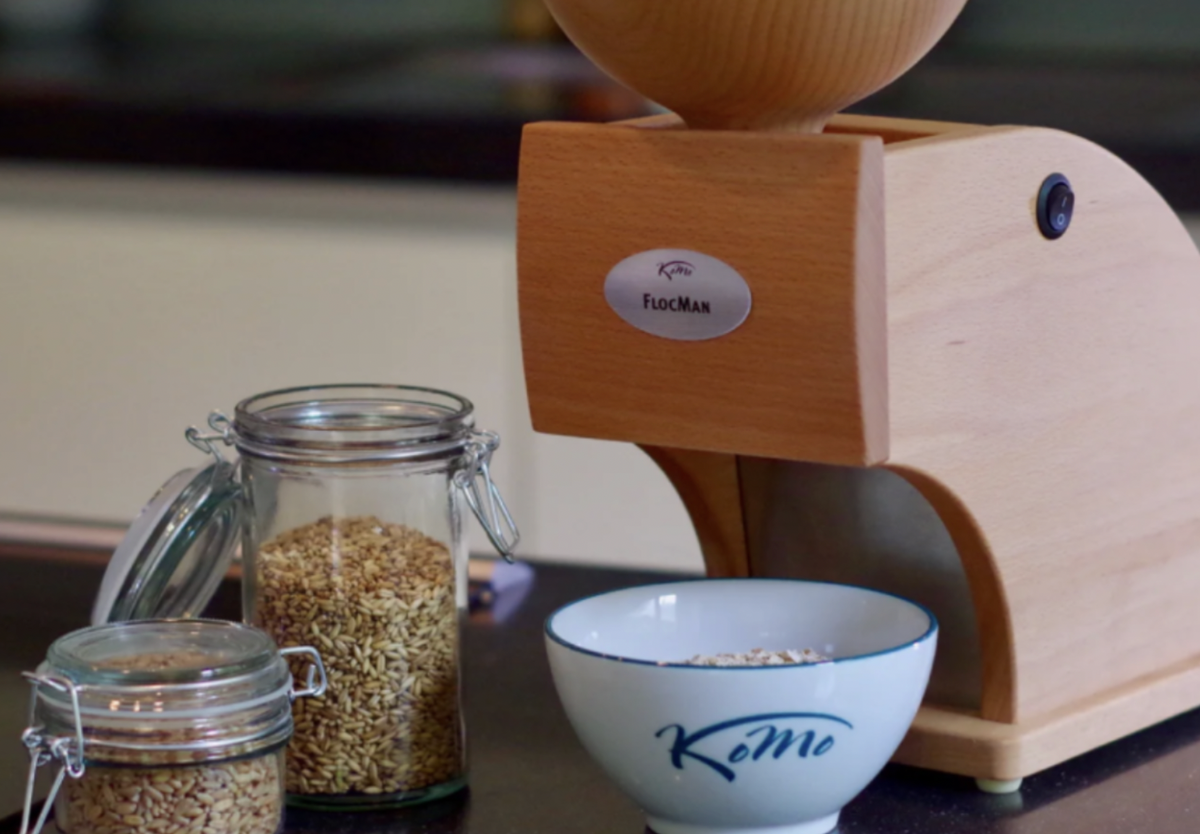
In brief: Whole grain keeps for a long time, but flour and flakes do not. If you process grain fresh, buy it whole, store it somewhere dry and well ventilated, then mill or roll it shortly before baking or breakfast. You need three things: a good supply, a device for processing it and a tin that helps your bread turn out well. Here’s what matters at each step.
Why process it fresh?
The germ, and with it fat, is contained within the whole grain. As long as the grain is intact, its outer layer protects this fat from the air. After milling, it reacts with oxygen, which is why wholemeal flour becomes stale or rancid over time, while whole grain stays good for many months in storage. Freshly milled or freshly rolled grain therefore tastes different: more full-bodied in bread and nuttier in muesli.
The second reason is control. You decide which grain to use — spelt, oats, rye or wheat — and how finely it is processed.
Step 1: Store grain properly
Grain needs three things: dryness, ventilation and protection from moths. Moisture causes it to go mouldy, an airtight plastic bag traps heat, and an open packet invites food moths in.
- For larger quantities: The KoMo Einkammer Getreidespeicher hangs on the wall, is 64 cm high and has a removable Plexiglas cylinder, so you can always see how much grain is left. According to KoMo, several storage units can be hung next to each other, with one for each variety (KoMo, Einkammer Getreidespeicher).
- For smaller quantities: Enamel tins keep out light and odours and can be cleaned thoroughly. The Riess Vorratsdose mit Eschenholzdeckel 1,35 l holds a good portion of oats or flour for the week. You’ll find more sizes in Storage Tins.
- Cool and dark: A storage cupboard away from the hob is better than the shelf above the sink.
Step 2: Roll flakes and mill flour
A flaker presses the grain flat between two rollers without milling it. This produces fresh oat flakes for porridge or muesli in just a few seconds. KoMo makes its flakers in a workshop in Tyrol. According to KoMo, the FlicFloc is secured to the tabletop with a screw clamp, has a beech multiplex and stainless steel casing, and a flaking mechanism made from nickel-free stainless steel (KoMo, FlicFloc). See what KoMo currently has available at KoMo.
You need a grain mill for flour. Look out for three things when buying one: whether the grind can be adjusted continuously, how much grain the hopper holds and whether the milling mechanism can handle oily seeds such as flaxseed or poppy seeds. Fat can clog a milling mechanism, so it is worth checking the instructions before milling them.
Step 3: Bake and slice
Freshly milled wholemeal flour absorbs more water than refined flour. So give your dough a little more liquid and more time to absorb it, often overnight. Wholemeal bread is easier to bake in a tin than free-standing, as the moist dough is supported.
- The tin: The Riess Classic Brotbackform is made from enamel. Riess has been making enamel in Ybbsitz, Lower Austria, for more than a hundred years — glass fused inseparably to steel in a kiln (Riess, FAQ). You’ll find more tins in Baking Tins.
- The knife: A substantial crust calls for a serrated edge. Made in Solingen, the Güde Alpha Olive Brotmesser 21 cm also slices dark wholemeal loaves cleanly without crushing the crumb. You’ll find more lengths among the Bread Knives.
Is it worth it for you?
If you eat muesli every week or bake bread regularly, yes. Whole grain lasts longer than flour from a packet, and the extra work takes just a few minutes. If you rarely bake, start small: one storage container, one bread tin and one good bread knife. Add the rest once you see how often you use them.
Frequently asked questions
What is the best way to store grain?
Somewhere dry, cool, dark and well ventilated, in a container that keeps moths out. Whole grain will keep for many months this way, while flour and flakes last considerably less time.
Can I make flour with a flaker?
No. A flaker presses the grain flat, while a mill grinds it into flour. Combination machines are available for both.
Why is my wholemeal bread too firm?
Usually, it needs more water or more time. Wholemeal flour absorbs liquid more slowly, so a longer proving time and a bread tin can help.
Find everything you need for your supplies and Sunday loaf at Sonntagsbrot.


