
Image source: Riess
In brief:Enamel is glass fused to steel: a non-porous cooking surface that withstands acids and can be cleaned completely. How pure it is depends on the manufacturer. In Germany's 2022 official monitoring programme, almost every second enamelled item failed to meet at least one limit in the enamel standard, usually because the aluminium limit had recently been reduced to one fifth; 8 of the 194 metal items tested raised health concerns. Tested enamel outperforms stainless steel for acids, hygiene and cleaning. Stainless steel outperforms enamel for impact resistance and sustained heavy use. Cast iron retains heat best, copper conducts it fastest, while a PTFE coating releases eggs and fish most easily. The table below compares all six cooking surfaces across the same five criteria: use, care, durability, material and health.
Author: Axel Böhm, founder of Taiga. Sources checked on 14 October 2026. Reading time: about 10 minutes.
What enamel is
Enamel is glass fused with metal. Riess describes it as easily melted glass made from silicates and oxides, applied to steel, cast iron or stainless steel and fused with the substrate in a kiln at around 850 degrees (Riess FAQ). The German Enamel Association gives firing temperatures of up to 900 degrees and describes the boundary layer as follows: metal and enamel are permanently fused together (German Enamel Association).
The structure consists of two layers:
- Ground coat sits directly on the steel. It contains small amounts of cobalt or nickel oxide, which ensure adhesion, and is fired at 850 to 900 degrees (Wikipedia: Enamel).
- Cover coat provides colour and gloss. Each layer is fired individually at 800 to 850 degrees. Depending on the model, Riess cookware has two to four layers (Riess FAQ).
The result is not a coating in the sense of a non-stick layer sitting on top of the metal. It is a composite material: the steel core provides shape and stability, as well as the magnetic response on an induction hob, while the glass forms the surface that comes into contact with your food.
Why the surface is so smooth: hardness, hygiene and purity
Hardness. Glass ranks 6 on the Mohs scale (Baunetzwissen). Enamel is glass, and the Enamel Association describes its surface as glass-hard, with the abrasion resistance typical of glass. Enamel scratch hardness is measured according to ISO 6769:2022, in which minerals of known Mohs hardness are drawn across the surface (BSI: ISO 6769). In everyday use, this means Riess expressly permits knives, forks and metal kitchen utensils on the cooking surface (Riess: Use and care). Being glass-hard also means being glass-brittle. Scratches are rare, but a hard impact on the rim can cause chipping.
Hygiene. A glass surface has no pores in which food residue, grease or germs can become trapped. Riess states that dirt cannot adhere to the smooth, non-porous surface and describes it as inhibiting bacterial growth; the Enamel Association says that enamel surfaces do not provide bacteria with a breeding ground. The most detailed figure comes from a study by Prof. F. Marzullo (Modena), commissioned by the Italian enamel association CISP: after cleaning with soapy water, significantly fewer germs remained on enamelled steel than on stainless steel or PTFE. Small scratches impaired cleaning on PTFE and painted surfaces, but not on enamel (IEI: Comparative bacteriological studies). The study is undated and was funded by the industry. We interpret it as an indication, not proof. The underlying mechanism is undisputed: a sealed glass surface can be cleaned completely.
Purity. Glass reacts very little with acids, salt or fat when intact and does not impart any off-flavour. This is why the DIN EN ISO 4531 standard tests enamel with 3% acetic acid for two hours at 70 or 95 degrees: a more demanding test than any tomato sauce (BfR 038/2025, page 21). The same measurements also reveal the downside. What the glass layer contains is determined by the manufacturer. In the nationwide 2022 monitoring programme, 53.2% of the 79 enamelled samples complied with all the limits in this standard. Most exceedances concerned aluminium (33 samples), whose limit was reduced from 5 to 1 mg per kg by the 2022 revision; individual items released lead (7 samples), cobalt (5) or cadmium (3). For 186 of the 194 metal items, the release did not exceed any health-based guideline value. From the BfR's perspective, the remaining 8 should not come into contact with food (BfR 038/2025, pages 4 to 5). With enamel, the manufacturer's test documentation therefore matters more than the word enamel on the label.
The comparison: six cooking surfaces in one table
| Criterion | Enamel on steel | 18/10 stainless steel | Bare cast iron | Enamelled cast iron | Copper, stainless steel or tin lining | PTFE coating |
|---|---|---|---|---|---|---|
| Cooking surface | Glass | Chromium oxide passivation layer | Iron with baked-on seasoning | Glass | Stainless steel or tin | Plastic (PTFE) |
| Acids, e.g. tomato | Very good with tested products | Good | Poor, removes the seasoning | Very good | Good, as long as the lining is intact | Good |
| Heat | Fast, moderate heat retention | Slow without a multi-layer base | Retains heat very well | Retains heat very well | Conducts heat fastest | Depends on the core, usually aluminium |
| Induction | Yes | With a magnetic base | Yes | Yes | Only with a steel plate | Only with an induction base |
| Weight | Light | Medium | Heavy | Very heavy | Medium to heavy | Light |
| Care | Easy, dishwasher-safe | Very easy | Season, dry and oil | Easy, hand washing recommended | Polish, replenish the tin lining | Gentle, never heat when empty |
| Durability | Decades with an intact interior | Decades | Decades, with seasoning that builds over time | Decades | Decades | Years, ending with the coating |
| Typical damage | Chips after impact | Dents, discolouration | Rust | Chips after dropping | Verdigris, exposed copper | Scratches, abrasion |
| Health, test results | Determined by the manufacturer (2022 monitoring) | Consistently unremarkable (AGES 2026) | Individual items releasing arsenic (AGES 2026) | Same as enamel | Uncoated, critical with acids | Safe as long as it is never overheated empty |
| Price range | Medium | Wide | Budget to medium | High | High | affordable |
The individual materials:
Enamel.Advantages: a pore-free glass surface, acid-resistant, does not affect taste, metal utensils permitted, lighter than cast iron. Riess states heat resistance up to 450 degrees, with a recommended operating temperature of up to 220 degrees (Riess FAQ). Disadvantages: no non-stick effect, sensitive to knocks and thermal shock. Quality depends heavily on the manufacturer.
Stainless steel.The trade designation 18/10 usually refers to 1.4301 steel, with around 18% chromium and 8 to 10.5% nickel (Klöckner: Data sheet 1.4301). Advantages: virtually indestructible, dishwasher-safe, withstands metal turners and knocks. In Austria's 2026 focused monitoring campaign, all stainless steel samples showed unremarkable results (AGES A-012-26). Disadvantages: with 15 W/(m·K), steel conducts heat poorly, so good pans need a sandwich base. It is not ferromagnetic and only works on induction with a magnetic base. Around 15% of the population in Germany is sensitised to nickel (BfR 038/2025, section 4.1.2.15); for them, acidic foods simmering for hours in glass or tested enamel are the more reassuring choice. Enamel can also release nickel: the adherent oxide sits in the base layer beneath the glass coating; in monitoring, 2 of 66 enamelled samples exceeded the limit.
Raw cast iron.Advantages: stores heat like no other material, ideal for high-heat searing, and its frying performance improves as the patina develops. Disadvantages: heavy, rusts without drying and oiling, and acid removes the patina. In ÖKO-TEST 6/2024, three of six uncoated pans released metals, one of them above the Council of Europe's reference values (ÖKO-TEST). In 2026, AGES objected to three cast-iron products because of increased arsenic release.
Enamelled cast iron.Advantages: the heat retention of cast iron combined with the acid resistance of glass, ideal for slow-cooked dishes. Disadvantages: very heavy, and a fall can shatter the glass coating. In the same ÖKO-TEST, two of four enamelled pans browned food unevenly, and two released cadmium above the EU reference value. Here too, everything depends on the manufacturer's glass coating.
Copper.At around 390 W/(m·K), copper conducts heat around 26 times better than 18/10 stainless steel (Aurubis: Data sheet Cu-ETP); sauces and sugar can be controlled with great precision. The drawbacks are its high price, demanding care and the need for a steel plate for induction; according to AGES, uncoated copper products can also release increased amounts of metal when in contact with acidic foods. Cooking is therefore done on the stainless steel or tin lining.
PTFE coating.Eggs, fish and pancakes slide off without fat, and the pan is light and affordable, but its lifespan is limited to that of its coating. According to the BfR, risks arise when empty cookware is heated intensely: harmful fumes can develop from 360 degrees; when used as intended, no adverse health effects are expected (BfR: Questions and answers on PTFE). PFOA, formerly used as a processing aid, has been banned in the EU since 4 July 2020 (Regulation (EU) 2020/784). An EU restriction covering the entire PFAS group, which also includes PTFE, is under discussion and has not been decided (CMS, 2026).
Which material for what
Enamel is not the best choice for everything. Here it falls short, and here it comes out on top.
- Steak and high-heat searing:Raw cast iron or wrought iron. Both retain heat and develop roasted flavours.
- Eggs, fish and pancakes without fat:A PTFE pan, handled with care. Enamel and stainless steel need fat and practice here.
- Sauces, stews, tomatoes, sauerkraut, jam, stock:Enamel. Acid and long cooking times are where it excels.
- Slow cooking in the oven:Enamelled cast iron or enamel on steel if you want to save weight.
- Professional kitchen, continuous use, metal utensils used all day:Stainless steel. A dent is not a defect in stainless steel.
- Delicate sauces, sugar, chocolate:Lined copper.
- Nickel-sensitive:Enamel with test documentation or glass.
Care and damage
The guidelines come from Riess: Use and care.
- Never heat while empty.Start on a low setting, then increase the heat gradually.
- Do not use the boost function on an induction hob.Riess states that it is not necessary for enamel cookware.
- Do not pour cold water into hot cookware.Thermal shock can cause cracks.
- Metal utensils on the surface are fine, but do not knock them against the rim.Forceful tapping on the rim of the pot can cause chips.
- No wire brushes, steel wool or abrasive cleaners containing grit.Soak burnt-on food.
- Dishwasher-safe,hand-washing keeps the shine for longer.
- Remove limescale marks with vinegar water.
- Store thoroughly dried,like glass.
The damage.A chip on the outside is a cosmetic flaw. If the steel is exposed on the inside, where it comes into contact with food, the item should be replaced: the glass coating is no longer intact. Fine losses of shine after years in the dishwasher are not a defect.
Riess in practice
Our cookware comes from Riess in Ybbsitz, Lower Austria. Iron has been processed there since 1550; the Riess family has run the business since 1690, now in its tenth generation, and enamelling has been carried out since 1922. According to its own information, Riess is Austria's only enamel cookware manufacturer (Riess: Since 1550). We do not stock stainless steel pots. We offer enamel on steel and wrought iron.
According to its own information, Riess has all its products tested for lead, cadmium, antimony, barium and zinc by the Lebensmitteluntersuchungsanstalt and OFI Wien, both accredited testing institutes, including in accordance with EN ISO 4531:2022 (Riess FAQ). Lead and cadmium are on this list. Aluminium, the most common finding in monitoring, is not explicitly mentioned; the EN ISO 4531:2022 standard used by Riess sets a limit of 1 mg per kg for it.
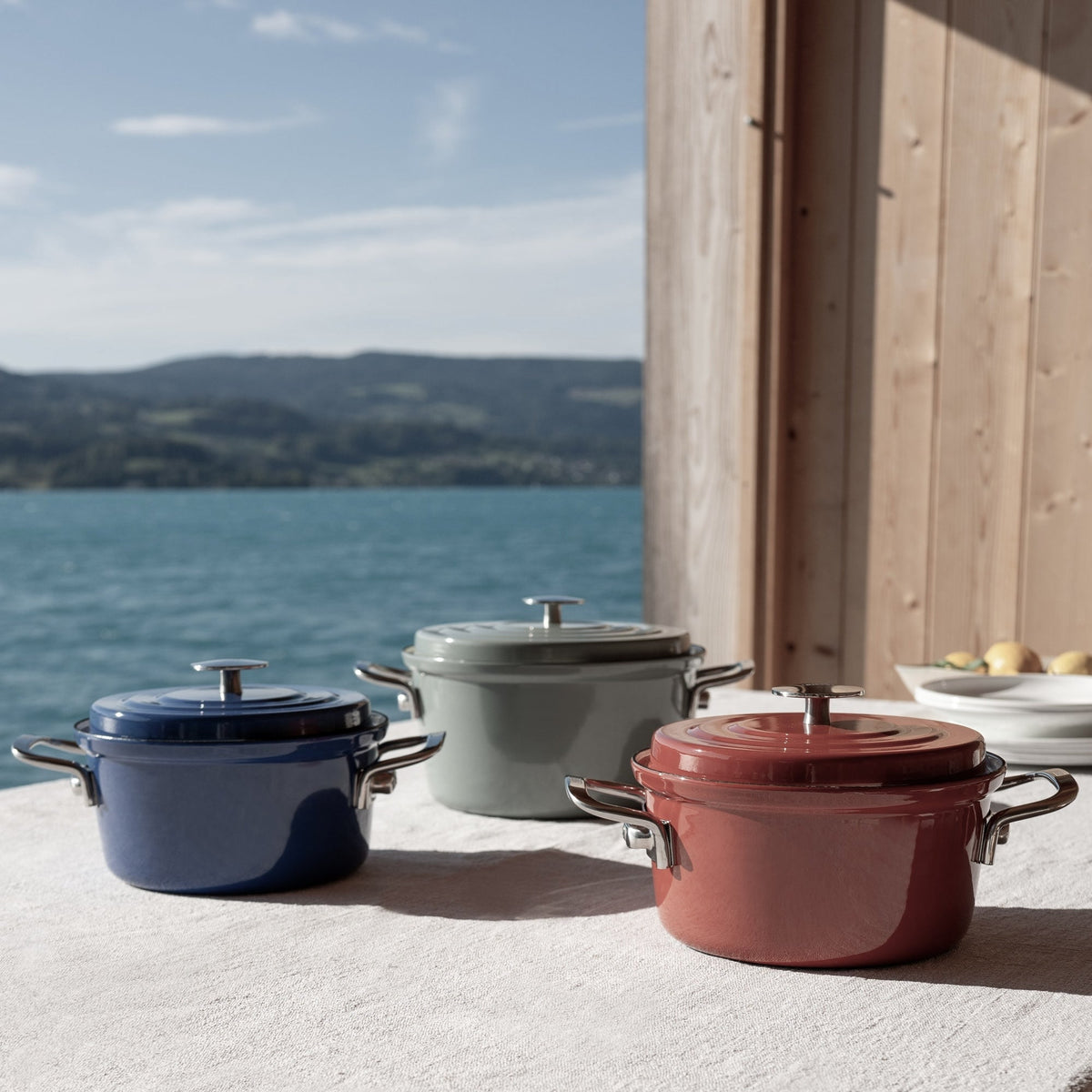
- The NOUVELLE stock pot with glass lid: emerald or Corall on the outside, light-coloured enamel on the inside, with a chrome rim protecting the edge from chips. Through the glass lid, you can see the stock reducing.
- The NOUVELLE saucepan with glass lid: the shallower sister model with the same stainless steel handles, for vegetables, rice and sauces.
- TheCLASSIC Holzknecht Pan Black: deep black enamel with a wooden handle, suitable for all hob types including induction; the handle stays outside the oven.
- The Classic Iron Pan: cold-forged iron without a coating and with a long handle; the patina darkens with every roast.
- The Aromapots Pot with Lid: white inside, Pure White, Light Grey or Slow Green outside, made entirely of steel and enamel. Turned upside down, the lid becomes a bowl.
You'll find all the pieces in the Riess collection and in thecookware.
Frequently asked questions
Is enamel healthier than stainless steel? Both are safe when the products have been tested. In Germany's 2022 monitoring programme, none of the 112 uncoated metal samples exceeded the limit for nickel of 0.14 mg per kg (BfR 038/2025, page 21), while all stainless steel samples tested in Austria in 2026 were unremarkable. The results varied more widely for enamel because the formulation of the glass coating is determined by the manufacturer. So look for proof of testing.
Is enamel really more hygienic? The glass surface has no pores and can be cleaned completely. Riess describes it as inhibiting bacteria, while the Enamel Association says bacteria find no breeding ground there. Independent comparative studies are rare; the available one was commissioned by the industry.
Can I cook tomato sauce in enamel? Yes. The enamel standard tests with hot acetic acid, which is more aggressive than any sauce. The requirements are a tested manufacturer and an intact inner surface. Raw cast iron and uncoated copper are the poorer choice for long cooking times with acidic foods.
What should I do if the enamel chips? On the outside: continue using it. On the inside, where it comes into contact with food: replace it, because the glass coating is no longer intact there.
Can enamel be used on induction hobs and in the oven? Yes. The steel core is magnetic. Riess advises against using the boost setting and recommends up to 220 degrees in the oven; wooden handles must stay outside.
Sources
All accessed on 14 October 2026.
- BfR statement 038/2025: Metal kitchen utensils (22 September 2025)
- BfR: Questions and answers about cookware with PTFE non-stick coating (2 July 2025)
- AGES focus campaign A-012-26: Metal release from pots, pans and uncoated metal cookware (July 2026)
- Regulation (EU) 2020/784 on PFOA, CMS: Status of PFAS restrictions (2026)
- Verbraucherzentrale NRW: Metal kitchen utensils (26 August 2026)
- ÖKO-TEST: Cast-iron pans tested (Issue 6/2024)
- German Enamel Association: Properties of enamel
- ISO 6769:2022, Scratch hardness of enamels according to Mohs
- IEI: Comparative bacteriological studies (commissioned study CISP, undated)
- Wikipedia: Enamel, Baunetzwissen: Mohs hardness
- Klöckner: Data sheet 1.4301, Aurubis: Data sheet Cu-ETP
- Riess: FAQ, Use and care, Since 1550
About the author: Axel Böhm is the founder of Taiga. More about us. More articles in the Conscious Living Magazine.