

In brief: Three knives are enough for almost everything you cut in the kitchen: a chef’s knife with a blade of around 20 cm, a bread knife with a serrated edge and a small paring knife. The steel, a handle that suits your hand and how you care for the knife afterwards matter more than the number of knives. Here you’ll learn what matters for each of the three and how to keep a good knife sharp for years.
How to recognise a good knife
Take an onion. A sharp knife glides through the layers without you having to press, and the pieces fall away cleanly. A blunt knife crushes it, makes your eyes water more and is more likely to slip. That’s why every professional kitchen follows the same rule: a sharp knife is a safe knife.
Three things determine how long that sharpness lasts:
- The steel. Stainless knife steel is easy to care for and forgiving if the knife is left wet for a while. Carbon steel often gets sharper and is easy to resharpen, but it will rust if you don’t dry it straight away.
- The hardness. This is measured in HRC, the Rockwell hardness scale. A harder blade keeps its edge for longer but is more brittle. Good European kitchen knives are usually just below 60 HRC, while many Japanese and hand-forged blades are above that.
- The construction. Forged knives have a bolster, the thickened section between the blade and handle. It protects your fingers and gives the knife weight and balance.
The three knives you really need
1. The chef’s knife
Use a chef’s knife to cut vegetables, herbs, meat and fish. A blade of around 20 cm offers the best balance of reach and control for most hands. If you prefer a shorter blade, choose 16 cm. In our range of chef’s knives, you’ll find, for example, the Güde Kochmesser 21 cm Alpha Fasseiche with handle scales made from the wood of old wine barrels, or the all-steel Güde Kappa Kochmesser 16 cm.
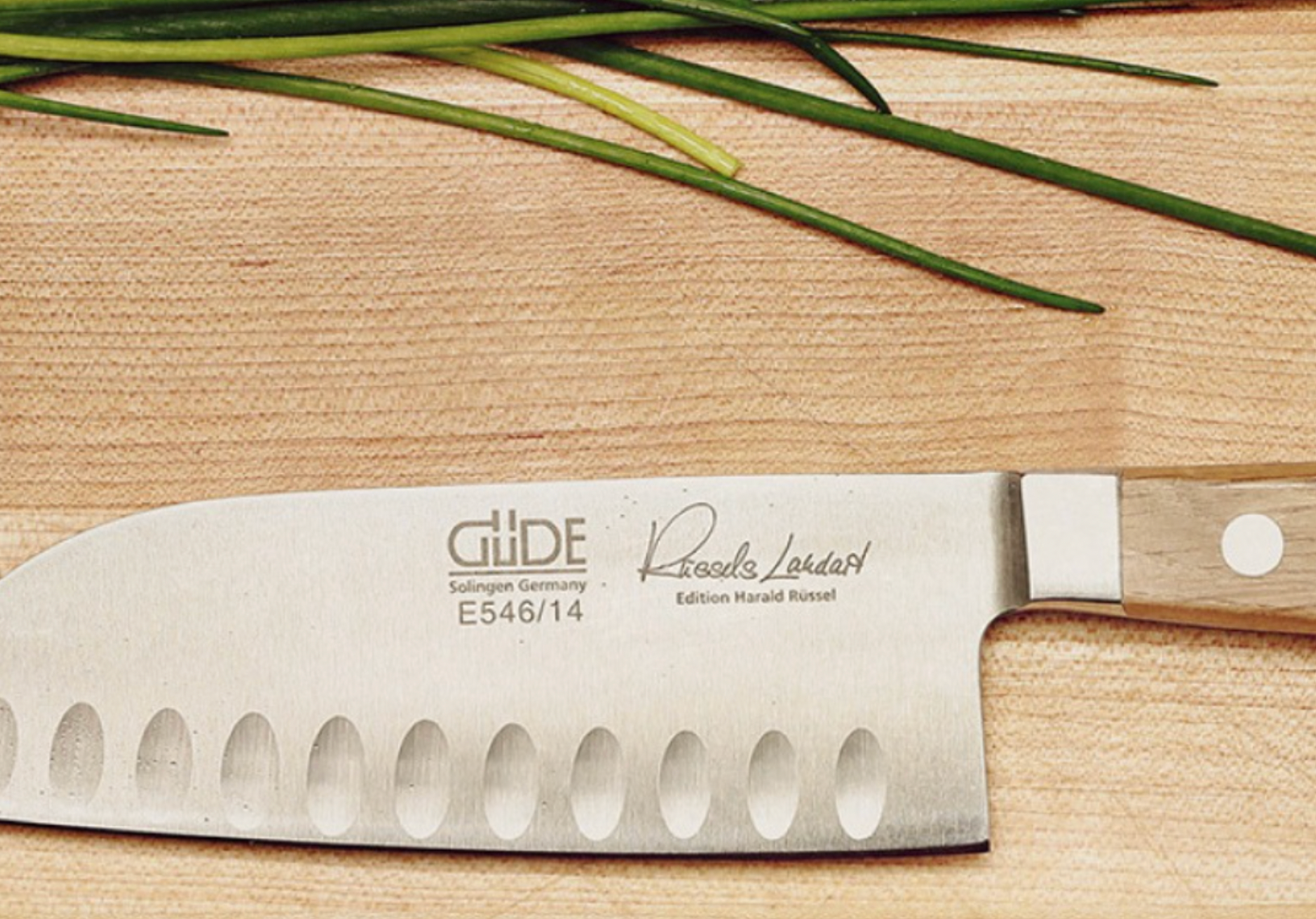
If you enjoy cutting fine slices, a santoku is a good alternative. This Japanese style has a broad blade with a flat edge. Small hollows in the blade, known as kullens, help prevent slices of potato or cucumber from sticking. One example is the Güde Alpha Olive Santoku 18 cm mit Kullen; you’ll find more in our range of santoku knives.
2. The bread knife
A serrated bread knife saws through a hard crust without crushing the soft crumb. Pay attention to the length: the blade should be wider than your largest loaf so you can cut through it in one stroke. Around 21 cm is enough for everyday use; longer blades are worthwhile for large farmhouse loaves. The Güde Alpha Olive Brotmesser 21 cm is a good place to start; you’ll find the full range among our bread knives.
3. The paring knife
For anything you do in your hand, you need a short blade: peeling garlic, coring apples and trimming radishes. A paring knife with an 8 to 10 cm blade is ideal, such as the Güde Kappa Gemüsemesser 9 cm. You’ll find more shapes among our paring knives.
Two ways to make a knife: Solingen and Cao Bang
Our selection includes knives from two places of origin, showing how differently good knives can be made.
Güde has been forging kitchen knives in Solingen for more than a hundred years. According to Güde, the steel is drop-forged, ice-hardened at minus 80 degrees and then tempered in two stages. The blades made from chromium-vanadium-molybdenum steel reach around 57 to 58 HRC, and up to 55 production steps are carried out by hand, from grinding to the final inspection (Güde, Fertigung).
Heritedge Viet Crafts is a Berlin brand that has its knives made in small family-run forges in Cao Bang province in northern Vietnam, without intermediaries. The Rua Classic has a rectangular carbon-steel blade with 60 to 61 HRC and a tamarind wood handle (Heritedge, Unsere Geschichte). It is sharper than most stainless-steel blades, but needs to be dried immediately.
How to keep your knife sharp
- Wipe it after cutting. Güde recommends cleaning every knife with a damp cloth immediately after use (Güde, Pflege und Aufbewahrung). Knives with wooden handles should not go in the dishwasher.
- Dry carbon steel immediately. Heritedge advises washing the knife by hand, drying it straight away and never leaving it in the sink. Over time, a dark patina forms to protect the blade (Heritedge, Pflegehinweise).
- Know the difference between honing and sharpening. A honing steel realigns the fine edge and belongs in your daily routine, such as the Güde Wetzstahl 26 cm Alpha Fasseiche. A sharpening stone removes material and is needed when honing is no longer enough.
- Cut on wood. Boards made from glass, stone or porcelain will blunt any blade in a short time. Wood or soft plastic is kinder to the edge.
- Store knives separately. Loose knives in a drawer knock against one another. A knife block or magnetic strip protects the edge.
Frequently asked questions
How many knives does a kitchen need?
Three cover almost everything: a chef’s knife, bread knife and paring knife. Add a santoku or filleting knife if you often cut fine slices or prepare whole fish.
Can Güde knives go in the dishwasher?
According to Güde, Kappa knives and knives with plastic handles can, but knives with wooden handles cannot. Güde recommends cleaning all of them with a damp cloth immediately after use.
What is the difference between carbon steel and stainless steel?
Carbon steel generally gets sharper and is easier to resharpen, but it will rust without immediate drying. Stainless steel is easier to care for and the more convenient choice for everyday use.
Find all shapes and sizes in our range of kitchen knives. Start with a chef’s knife: it’s the knife you’ll have in your hand every day.


